Five checks to work through before your first postpartum run, based on the 2019 UK return-to-running guideline and the 2024 international consensus.
You’ve had your baby, you’ve been cleared, and you’re walking comfortably. Your body is telling you it wants more. So when can you run?
Walking and running ask very different things of your body. Running at a moderate pace sends roughly 1.6 to 2.5 times your bodyweight through your legs and pelvis with every stride [1]. Your pelvic floor and abdominal wall have to manage that load, step after step, while they are still recovering from pregnancy and birth.
There is no single date when every woman is ready. The research and expert guidance point to a set of checks instead. Here are five of them, in order. The first two are gates to pass before you try anything; the next two you can check yourself; the last one you keep using every time you run.
Step 1: Healed and checked
- Any tears, stitches or caesarean wound are fully healed
- You’ve had your postnatal check with your GP or obstetrician
- Your bleeding has settled
Why it matters. Tissue healing comes before impact, whatever your fitness. The 2024 international consensus agreed that no one should start running before 3 weeks postpartum, and that any birth injury must be completely healed first [2].
What about the “3-month rule”? The 2019 UK guideline recommended low-impact exercise for the first 3 months, then a return to running between 3 and 6 months at the earliest [1]. The 2024 consensus moved to a person-specific timeline instead, after a period of rest and a gradual build of fitness and strength [2]. Some women who returned to exercise early had similar pelvic floor outcomes at one year to those who waited [2].
That is not a reason to rush. Three weeks is a floor, not a target. If you’re thinking of running before 3 months, make that call with a pelvic health physio, not on your own.
Red flag. Bleeding that continues or returns beyond 8 weeks, and isn’t your period, needs a check-in with your care provider before you run [1].
Step 2: Get a pelvic health assessment
- You’ve seen a pelvic health physiotherapist, ideally including an internal assessment
Why it matters. Some of the most important things to check can’t be felt or self-tested. A pelvic health physio can assess how well your pelvic floor contracts, relaxes and coordinates. They can also check how well your pelvic organs are supported. The 2019 guideline recommends every mother be offered this assessment from 6 weeks postpartum, whatever her mode of birth [1].
It’s never too late. The 2024 consensus is explicit: if you’re returning to running 2 years after birth, you should still be screened, because pregnancy-related changes may still be present [2].
The good news. If something is found, pelvic floor muscle training has strong evidence for treating urinary incontinence [3]. Support devices such as a vaginal pessary can also help with prolapse and leaking symptoms; the 2024 consensus agreed on this unanimously [2]. Finding an issue doesn’t mean you can’t run. It usually means you’ll get there with a plan.
Step 3: The impact check
Can you do all of these with no leaking, heaviness, dragging or pain?
- Walk for 30 minutes
- Balance on one leg for 10 seconds, each side
- Single-leg squat ×10, each side
- Jog on the spot for 1 minute
- Forward bounds ×10
- Hop on one leg ×10, each side
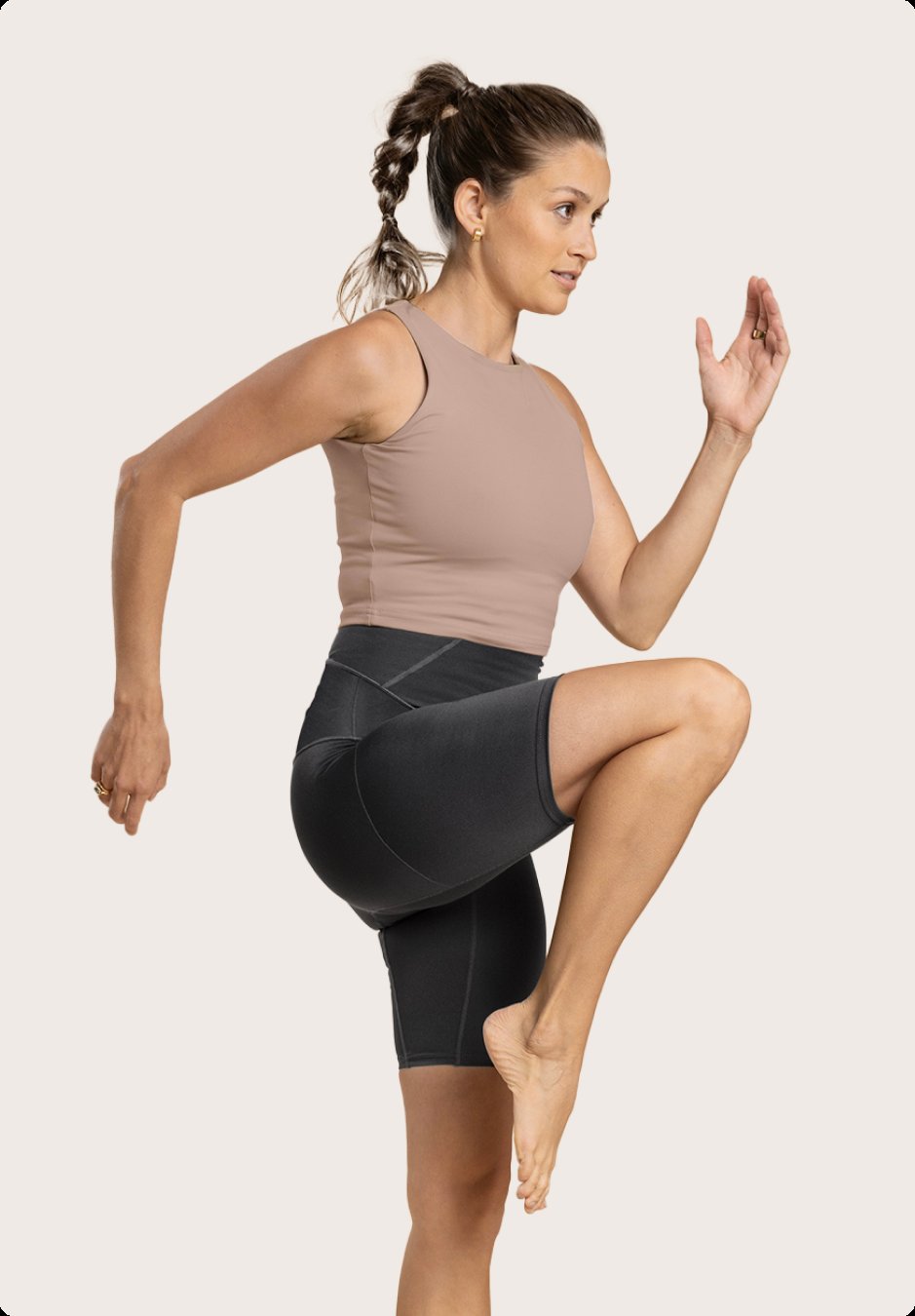
- “Running man” ×10 each side: stand on one leg and swing the opposite arm and bent knee forward and back
This is the load and impact screen from the 2019 guideline [1].
Why walking isn’t enough. Walking doesn’t test how your body handles impact, and impact is what running is. The 2024 consensus recommends a gradual series of load and impact challenges before your first run, to see whether they bring on symptoms [2]. In healthy runners, hopping in place, jogging on the spot and forward bounds produced about 76%, 87% and 104% of the vertical forces of fast running [2]. That makes them a safe way to find out how your body copes, in your lounge room rather than 3 km from home.
Strength counts too. The 2019 guideline also suggests working towards about 20 reps each of single-leg calf raises, single-leg bridges, single-leg sit-to-stands and side-lying leg lifts [1]. Falling short isn’t a barrier to running. It simply shows where to focus your strength work [1].
If you don’t pass. Note what you felt and when, and take that to your pelvic health physio. It’s useful information, not a fail.
Step 4: The life check
- You’re getting enough sleep to recover, or can plan runs around the sleep you do get
- You’re eating and drinking enough, especially if you’re breastfeeding
- If you’re feeding, you’ll feed or express before you run
- You have a supportive, professionally fitted sports bra
- You’ve checked your running shoes still fit
- You’re running because you want to, not to “get your body back” or to cope with low mood on your own
Why it matters. Recovery isn’t only physical. The 2024 consensus agreed unanimously that sleep, fatigue, mental health and pre-existing conditions should be checked before a postpartum return to running [2]. It also agreed on screening for low energy availability, milk supply and hydration [2].
Feeding and fuel. Breastfeeding uses about 700 mL of water a day and roughly 500 extra kilocalories a day above pre-pregnancy needs [2]. Under-fuelling raises the risk of injury and slows recovery. Most experts in the consensus (88%) agreed that feeding or expressing before a run helps [2].
Breasts and feet change. Breasts can grow by one or more cup sizes during pregnancy, and a professionally fitted bra reduces exercise-related breast pain [2]. Foot size can also change permanently with pregnancy, so don’t assume your old shoes still fit [1].
Mood. Postnatal depression affects up to about 1 in 5 mothers [1]. Running can be great for mental health, but if it has become your only coping strategy, talk to your GP or maternal child health nurse as well.
Step 5: Know your traffic lights
Once you start, check in with your body after every run.
| Signal | What you notice | What to do |
|---|---|---|
| Green | No symptoms, or mild muscle soreness (0–3/10) that’s gone by the next day | Keep going and progress gradually |
| Amber | Mild heaviness, or more tiredness or soreness than expected, that settles quickly | Repeat this week’s stage before progressing |
| Red | Any leaking, a bulge or dragging feeling, new bleeding, or pain lasting into the next day | Stop progressing and see your pelvic health physio |
Why it matters. The 2019 guideline names heaviness, dragging, incontinence and moderate-to-severe pain as signs that distance or intensity is too high [1]. It treats mild muscle soreness, around 0–3 out of 10, that settles quickly and doesn’t last into the next day as often acceptable [1].
How to progress. Start small: the guideline suggests around 1 to 2 minutes of easy running, with walk breaks [1]. Build total time or distance before you add speed. A rough guide is no more than about 10% more running each week, although small absolute jumps early on, such as 1 to 2 minutes, are usually fine [1]. A structured walk-run program helps you do this without guesswork; the 2024 consensus published separate guidance on designing one [4].
Keep runs conversational at first. Faster running raises the pressure inside your abdomen, which loads your pelvic floor more [7].
“But my pelvic floor is strong”
A strong squeeze is a good thing, but it isn’t the whole story. Researchers in Canada compared experienced runners who leak while running with runners who don’t. The runners who leaked actually had better pelvic floor contractions, but less passive support from their connective tissues [6]. After a single run, both groups showed a temporary drop in pelvic floor support, with no change in muscle strength [8].
The takeaway isn’t to stop doing pelvic floor exercises. They remain the first-line treatment for leaking, with strong evidence behind them [3]. The takeaway is that strength alone doesn’t tell you you’re ready. That’s why the impact check and how you feel during and after runs matter so much.
Leaking is common, but it isn’t normal
Leaking during exercise is one of the most common reasons women stop or cut back. In a review of nearly 15,000 women, urinary leakage affected exercise participation for about 1 in 2 of those with symptoms [9]. In a survey of 881 postpartum runners, leaking before or during pregnancy was the strongest predictor of leaking after birth [5]. If that’s you, see a pelvic health physio early, ideally before your baby arrives.
It’s treatable. You don’t have to put up with it, and you don’t have to give up running.
What this checklist can’t tell you
This is a screen, not a clearance. The checks in this article come from expert consensus, not trials. No study has yet shown which tests best predict a symptom-free return to running [1, 2]. Passing every box doesn’t replace a pelvic health assessment, and failing one isn’t a disaster. It just means there’s something to work on first.
Try not to let fear hold you back, either. In the same survey of postpartum runners, women with less fear of movement were more likely to get back to their pre-pregnancy running [5]. Take your time, check in with your body, and get the right support.
Ready for your first steps? Try a structured walk-run program like SheFitt’s Postpartum Return to Run.
This article is general information and is not a substitute for individual advice from your health professional.
References
- Goom T, Donnelly G, Brockwell E. Returning to running postnatal – guidelines for medical, health and fitness professionals managing this population. March 2019. Full guideline (PDF)
- Christopher SM, Donnelly G, Brockwell E, Bø K, Davenport MH, De Vivo M, et al. Clinical and exercise professional opinion of return-to-running readiness after childbirth: an international Delphi study and consensus statement. Br J Sports Med. 2024;58(6):299–312. doi:10.1136/bjsports-2023-107489. Full text
- Dumoulin C, Cacciari LP, Hay-Smith EJC. Pelvic floor muscle training versus no treatment, or inactive control treatments, for urinary incontinence in women. Cochrane Database Syst Rev. 2018;(10):CD005654. doi:10.1002/14651858.CD005654.pub4
- Deering RE, Donnelly GM, Brockwell E, Bø K, Davenport M, De Vivo M, et al. Clinical and exercise professional opinion on designing a postpartum return-to-running training programme: an international Delphi study and consensus statement. Br J Sports Med. 2024. doi:10.1136/bjsports-2023-107490. Record
- Moore IS, James ML, Brockwell E, Perkins J, Jones AL, Donnelly GM. Multidisciplinary, biopsychosocial factors contributing to return to running and running related stress urinary incontinence in postpartum women. Br J Sports Med. 2021;55(22):1286. doi:10.1136/bjsports-2021-104168. Article
- Bérubé MÈ, McLean L. Differences in pelvic floor muscle morphology and function between female runners with and without running-induced stress urinary incontinence. Neurourol Urodyn. 2023. doi:10.1002/nau.25274
- Bérubé MÈ, Niederauer S, Graham R, Hitchcock R, McLean L. The feasibility of using an intravaginal intra-abdominal pressure sensor during running to evaluate pelvic floor loading and its association with running-induced stress urinary incontinence: an observational cohort study. Int Urogynecol J. 2024;35:2211–2221. Abstract
- Bérubé MÈ, McLean L. The acute effects of running on pelvic floor morphology and function in runners with and without running-induced stress urinary incontinence. Int Urogynecol J. 2024;35(1):127–138. doi:10.1007/s00192-023-05674-3. PubMed
- Dakic JG, Hay-Smith J, Cook J, Lin KY, Calo M, Frawley H. Effect of pelvic floor symptoms on women’s participation in exercise: a mixed-methods systematic review with meta-analysis. J Orthop Sports Phys Ther. 2021;51(7):345–361. doi:10.2519/jospt.2021.10200. PubMed